
ADA Compliant Bathroom Maryland Accessible Design That Works for Every Stage of Life
Most Maryland homes were not built with accessibility in mind. Standard tub heights, narrow doorways, slippery floors and no grab bars make bathrooms one of the most dangerous rooms in the house and one of the first that needs attention as mobility needs change.
An ADA compliant bathroom renovation is not just a compliance project. It’s an investment in safety, independence and long-term property value particularly in Maryland’s growing 55+ buyer and renter market.
At Fortune Homes MD, we design and build fully accessible, ADA compliant bathrooms across all 7 Maryland counties. Grab bar installation, roll-in showers, curbless entries, accessible vanities, widened doorways one team handles every element from permit to final inspection.
We serve: Baltimore County · Montgomery County · Howard County · Prince George’s County · Anne Arundel County · Frederick County · Carroll County
📞 Call Now: (410) 413-0739 | 📧 Email: info@fortunehomesmd.com
What We Install & Modify
- ✅ Grab bar installation toilet, shower, tub zones
- ✅ Curbless / zero-threshold roll-in shower conversion
- ✅ Walk-in bathtub installation
- ✅ ADA-height comfort toilet installation (17″–19″)
- ✅ Accessible floating vanity knee clearance underneath
- ✅ Widened doorway minimum 32″–36″ clear width
- ✅ Non-slip flooring tile, vinyl and epoxy options
- ✅ Lever-handle faucets and door hardware
- ✅ Lowered mirror installation (bottom edge ≤ 40″)
- ✅ Blocking in walls for future grab bar additions
- ✅ Turning radius clearance 60″ diameter wheelchair space
- ✅ Maryland permit compliance fully managed by our team
Why Maryland Property Owners Choose Fortune Homes MD
- ✅ MHIC-licensed Maryland remodeling contractor
- ✅ Experienced in ADA standards for both residential and commercial applications
- ✅ Full in-house team plumbing, electrical, carpentry, tile no subcontractors
- ✅ Investment-focused accessible features that add resale value, not just compliance
- ✅ Maryland permit expertise across all 7 counties
- ✅ Transparent, fixed-price contracts no surprises mid-project
Before getting into specific features, it’s important to understand two distinct but overlapping scopes of work we handle.
ADA Compliance (Commercial / Public Buildings)
The Americans with Disabilities Act sets strict, legally enforceable standards for public accommodations, commercial buildings, healthcare facilities, and government properties. These standards include precise dimensions, door widths, turning radii, grab bar heights, fixture clearances that must be met exactly.
ADA standards apply to:
- Maryland commercial properties and retail spaces
- Multi-family buildings (apartments, assisted living)
- Healthcare and medical facilities
- Government buildings and public restrooms
- Any property open to the public
Aging-in-Place / Accessible Design (Residential)
Private Maryland homes are not legally required to meet ADA commercial standards but the same accessibility principles applied to residential bathrooms dramatically improve safety, usability and property value for homeowners planning to age in place or targeting accessibility-focused buyers and renters.
Residential accessibility upgrades are ideal for:
- Homeowners planning to remain in their home long-term
- Maryland property owners targeting 55+ buyers or renters
- Families with a member who has a mobility limitation
- Investors targeting short-term rental properties (accessible amenity)
- Anyone recovering from injury or surgery
At Fortune Homes MD, we build ADA commercial standards for commercial projects and apply ADA-equivalent principles to residential accessibility renovations giving you the benefit of professional accessible design regardless of your property type.
Here are the specific ADA standards we design and build to. These measurements apply to commercial properties and are used as the design target for residential accessibility renovations.
Doorway & Entry Requirements
- Minimum clear door width: 32″ when door is open at 90° (36″ preferred for comfortable wheelchair access)
- Maneuvering clearance on latch side of door: 18″ minimum on pull side, 12″ on push side
- Door hardware: Lever handles required knobs are not ADA compliant
- Threshold height: Maximum ¼” without treatment; maximum ½” if beveled at 1:2 slope
- Automatic or low-force door closers recommended for wheelchair users
Maryland homes commonly need: Door widening from standard 24″–28″ to 32″–36″, threshold removal or ramping, and hardware replacement from knobs to levers.
Turning Space Requirements
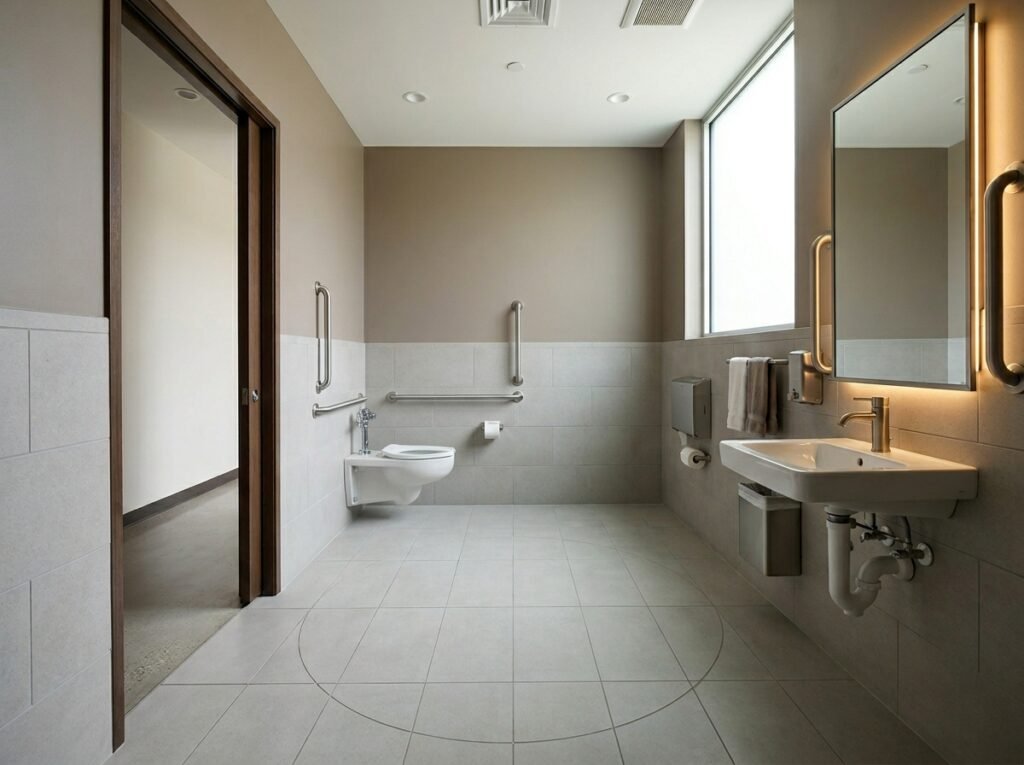
- Wheelchair turning radius: 60″ diameter clear circle (or T-shaped space within a 60″x60″ area)
- Clear floor space in front of all fixtures: Minimum 30″x48″ approach space
- Obstruction-free path throughout the bathroom no cabinets, doors or fixtures blocking wheelchair navigation
What this means for Maryland bathrooms: Many standard Maryland bathrooms particularly in older Baltimore rowhouses and 1970s–1990s suburban homes are 5’x7′ or 5’x8′. Creating a full 60″ turning radius in these spaces often requires removing a vanity, relocating fixtures, or reconfiguring the bathroom layout. We assess this during the free on-site visit and recommend the most cost-effective approach.
🔶 Not Sure What Your Property Needs for ADA Compliance?
We perform a FREE accessibility assessment measuring all dimensions, identifying non-compliant elements and giving you a clear scope of work.
📞 Call: (410) 413-0739 📧 Email: info@fortunehomesmd.com
Also Explore:
- Bathroom Remodeling Maryland
- Walk-In Shower Maryland
- House Remodeling Maryland
Toilet Requirements
- Toilet seat height: 17″–19″ from finished floor to top of seat (standard toilets are 15″–16″ not ADA compliant)
- Clear floor space: 60″ wide minimum in front of toilet for wheelchair side approach
- Centerline position: 16″–18″ from side wall to toilet centerline
- Grab bars side wall: 42″ long minimum, mounted 33″–36″ from floor
- Grab bars rear wall: 36″ long minimum, mounted 33″–36″ from floor
- Flush controls: Located on the open (non-wall) side of the toilet lever or automatic flush preferred
- Toilet paper dispenser: 7″–9″ from front of toilet, 15″–48″ from floor
What we install:
- ADA-height comfort toilets (TOTO, Kohler, American Standard)
- Grab bar blocking in walls allows future grab bar installation without structural work
- Grab bars in stainless steel, chrome or matte black finishes
- Wall-mounted sensor flush systems
Sink & Vanity Requirements
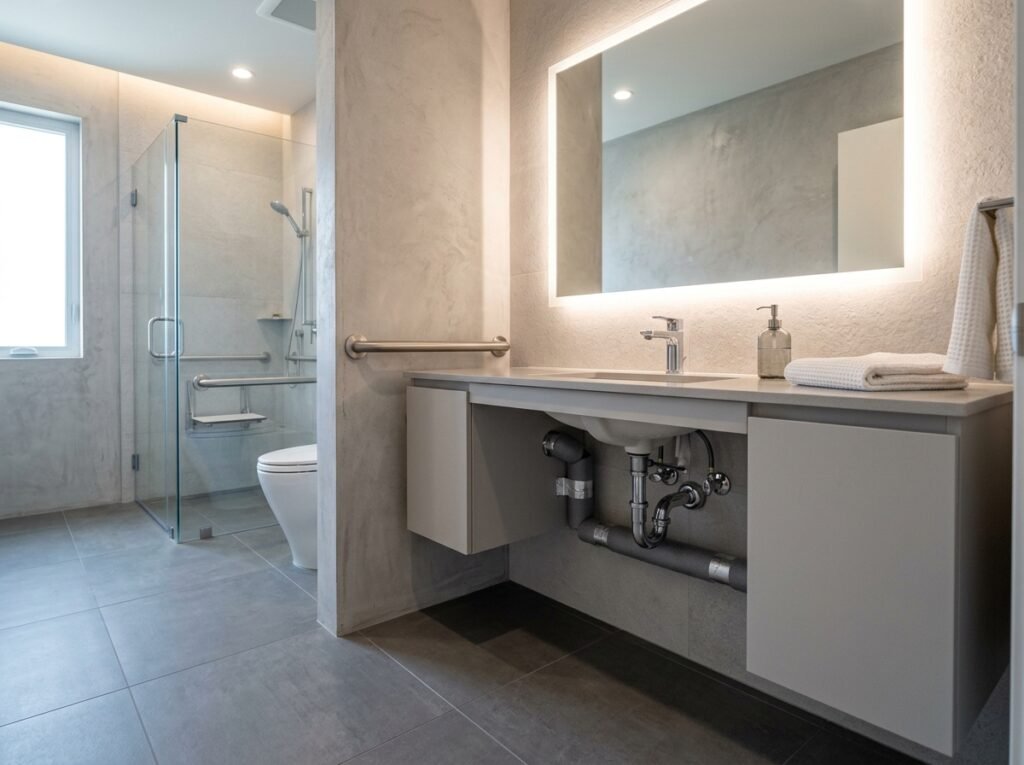
- Counter height: Maximum 34″ from floor to top of counter
- Knee clearance underneath: Minimum 27″ high × 30″ wide × 19″ deep
- Toe clearance: Minimum 9″ high × 30″ wide beneath the vanity
- Pipe insulation: Exposed drain and supply pipes must be insulated to prevent burns for wheelchair users with limited sensation
- Faucet controls: Single-lever, touch-activated or sensor faucets no twist knobs
- Mirror bottom edge: No higher than 40″ from floor (or tilting mirror)
- Soap and accessory reach range: 15″–48″ from floor (forward reach) or 9″–54″ (side reach)
What we install:
- Wall-mounted floating vanities with open knee clearance
- Lever faucets in accessible configurations
- Pipe insulation wrap on exposed supply and drain lines
- Low-mount mirrors or tilt-frame mirrors
- Sensor faucet upgrades
Shower Requirements
- Minimum shower size: 36″×36″ (transfer shower) or 30″×60″ (roll-in shower)
- Preferred roll-in shower size: 36″×60″ minimum allows wheelchair entry without transfer
- Entry threshold: Zero curb (curbless) maximum ½” level change
- Shower seat: Built-in fold-down or fixed bench seat, 17″–19″ from floor
- Grab bars in shower: L-shaped or horizontal bars on all walls 33″–36″ from floor
- Showerhead: Hand-held with 59″ minimum hose length, mounted on adjustable slide bar
- Controls placement: On the wall adjacent to the shower entry reachable before entering
- Non-slip shower floor: DCOF wet rating ≥ 0.42 required on all shower flooring
What we build:
- Full curbless roll-in shower conversions
- Tub-to-roll-in-shower conversions
- Fold-down teak or composite shower bench
- ADA grab bar installation with proper wall blocking
- Handheld showerhead on adjustable bar
- Offset controls for safe operation before entering
1. Grab Bar Installation
The single most impactful accessibility upgrade in any Maryland bathroom and one of the fastest to install.
Where Grab Bars Go:
- Toilet side wall: 42″ horizontal bar at 33″–36″ height
- Toilet rear wall: 36″ horizontal bar at 33″–36″ height
- Shower entry: Vertical bar at 18″ from shower opening
- Shower interior: L-shaped horizontal + vertical combination bar
- Bathtub: Side bar 24″–36″ along tub length + rear bar
Grab Bar Materials and Finishes:
- Stainless steel Most durable, commercial standard
- Chrome Classic residential look
- Matte black Modern aesthetic, matching current Maryland fixture trends
- Brushed nickel / brushed gold Transitional and contemporary homes
- Decorative grab bars Styled to look like towel bars (ADA-rated strength with residential aesthetics)
Critical Installation Note Wall Blocking: Grab bars must be anchored into wall studs or blocking not just drywall. A grab bar rated to support 250 lbs pulled from drywall alone will fail and cause injury. Every Fortune Homes MD grab bar installation includes proper structural anchoring, and we add wall blocking to any area that needs it before bar installation.
Cost per grab bar installed: $125 – $400 depending on bar length, material and wall blocking required Timeline: 1–4 hours per bar (same-day installation for simple swaps on existing blocking)
2. Curbless Roll-In Shower Conversion
The cornerstone of a fully accessible Maryland bathroom is a shower with zero-threshold entry that accommodates wheelchairs, walkers and users with any level of mobility.
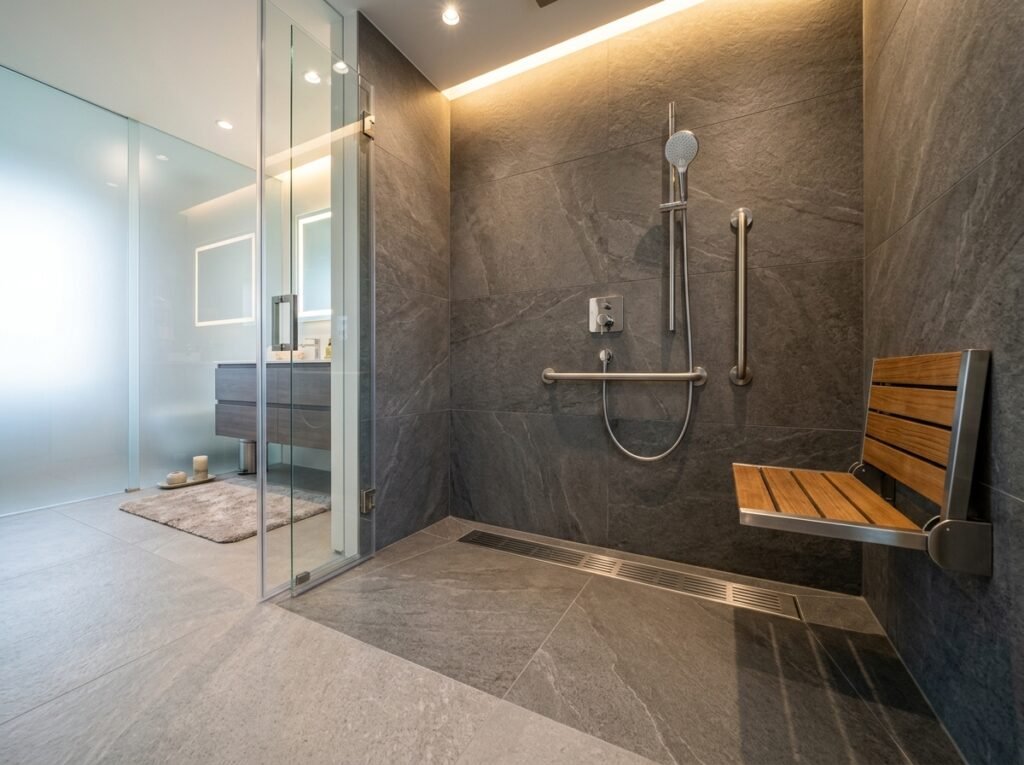
What Makes a Roll-In Shower Different: Unlike a standard shower with a 4″–6″ curb, a roll-in shower has a completely flat entry the floor transitions from bathroom tile to shower floor with no step, curb or barrier. Water is contained by a sloped mortar bed draining to a linear or center drain.
What We Build:
- Precision-sloped mortar bed 1/4″ per foot slope to drain in all directions
- Linear drain installation (preferred for roll-in showers single-slope floor)
- Full waterproofing membrane walls and floor
- Non-slip tile floor (mosaic or textured porcelain)
- Fold-down shower bench 17″–19″ seat height
- ADA grab bars on all three walls
- Handheld showerhead on 59″ minimum flexible hose
- Offset shower controls operable before entering
- Frameless glass panel or curtain rod (no swinging door into wheelchair path)
Investment Range: $6,000 – $18,000+ installed Timeline: 2–3 weeks
Learn more → Tub to Shower Conversion Maryland
3. Accessible Vanity Installation
Standard bathroom vanities are not wheelchair accessible. They sit on the floor, blocking knee clearance, and are typically mounted at 32″–34″ right at the maximum ADA height but with no clearance underneath.
What an Accessible Vanity Requires:
- Wall-mounted (floating) cabinet at maximum 34″ counter height
- Open knee space: 27″ high × 30″ wide × 19″ deep minimum beneath the counter
- Toe clearance: 9″ high × 30″ wide
- Exposed plumbing must be insulated
- Lever or sensor faucet
Our Accessible Vanity Options:
- Open-shelf floating vanity maximum knee clearance, minimal storage
- Wall-mounted vanity with open base floating look with side storage
- Custom wall-mounted cabinet sized to leave exact knee clearance
- Pedestal sink with knee clearance (no cabinet storage)
Cost installed: $600 – $2,500 depending on vanity style and plumbing work required
Learn more → Bathroom Vanity Installation Maryland
4. ADA Toilet Installation
Standard toilet seats are 15″–16″ high too low for most users with mobility limitations to safely transfer on and off. ADA-height toilets raise the seat to 17″–19″ the same height as a standard chair.
Options We Install:
Comfort Height / ADA Toilet (Most Common) A toilet manufactured at 17″–19″ seat height the most practical replacement for any Maryland bathroom with mobility concerns.
- Cost installed: $300 – $900
- Brands: TOTO, Kohler, American Standard
- Timeline: 1–3 hours (same-day replacement)
Wall-Hung Toilet A toilet mounted to the wall with a concealed tank height is fully adjustable during installation, floor is completely open for cleaning and wheelchair access.
- Cost installed: $800 – $2,500 (includes concealed tank carrier frame)
- Timeline: 1–2 days
- Best for: Full accessible bathroom builds, commercial properties, premium residential renovations
Raised Toilet Seat (Non-Structural Option) A removable seat riser added to an existing toilet adds 2″–6″ of height without plumbing work.
- Cost: $25 – $150 (user-installed, not a permanent modification)
- Best for: Temporary accessibility needs or rental properties where permanent changes aren’t desired
5. Non-Slip Flooring
The ADA requires that compliant bathroom floors be stable, firm and slip-resistant. In Maryland’s humid bathroom environments, this is especially critical.
Non-Slip Flooring Options We Install:
Textured Porcelain Tile Our top recommendation for Maryland accessible bathrooms non-porous, mold-resistant, durable and available with DCOF wet ratings well above the 0.42 minimum.
- Best formats: 12″×12″ or 2″×2″ mosaic for wet areas
- Cost: $7–$20/sq ft installed
Luxury Vinyl Plank / Tile (LVT) 100% waterproof, soft underfoot, warm surface texture and slip-resistant excellent for accessible bathroom floors where comfort is a priority.
- Cost: $4–$12/sq ft installed
Anti-Slip Epoxy Coating Applied over existing tile or concrete adds a textured, high-grip surface without replacing the floor.
- Cost: $3–$8/sq ft applied
- Best for: Quick accessibility upgrades in rental properties or commercial bathrooms
Threshold Removal and Transition Treatment Level changes at bathroom doorways are a trip and wheelchair navigation hazard. We remove raised thresholds and install beveled transition strips meeting the ADA’s ¼”–½” maximum level change standard.
Our ADA Bathroom Installation Process
Step 1 Free Accessibility Assessment We visit your property, take full measurements of every doorway, fixture clearance and turning space. We compare existing conditions against ADA standards and your specific accessibility goals. We identify every non-compliant element and every modification required at no cost.
Step 2 Scope & Prioritization Not all accessibility modifications need to happen at once. We help you prioritize: which changes deliver the most immediate safety impact (grab bars, non-slip floor, toilet height), which require structural work (widened doorways, plumbing relocation), and which are long-term investments (full roll-in shower, accessible vanity).
Step 3 Design & Material Selection We present accessible design options that meet ADA requirements without compromising aesthetics. Modern accessible bathrooms look intentionally designed, not institutional. We select grab bar finishes, tile choices and vanity configurations that achieve compliance and look great.
Step 4 Permit Filing Structural modifications (door widening, wall blocking, plumbing relocation) require Maryland county building permits. Commercial ADA compliance work always requires permits. We manage all applications and county inspection scheduling.
Step 5 Structural Prep Door framing is widened if required. Wall blocking is added for grab bars. Subfloor modifications for curbless shower slope are completed. This structural work happens before any surface installation.
Step 6 Plumbing & Electrical Plumbing is repositioned for accessible toilet placement and clearances. Lever faucets and sensor fixtures are roughed in. Lighting is updated if assessment identifies visibility issues. GFCI outlets are verified at all required locations.
Step 7 Flooring & Tile Non-slip tile or LVT flooring is installed throughout. Shower waterproofing and mortar bed are built for curbless entry. All thresholds and level transitions are treated to ADA standard.
Step 8 Fixture & Feature Installation Accessible toilet, floating vanity, fold-down shower bench, handheld showerhead and grab bars are all installed. All plumbing is tested and all fixtures are verified for ADA-compliant placement.
Step 9 Final Compliance Check & Inspection We measure every key dimension against ADA standards turning space, grab bar heights, fixture clearances, door widths. County inspection is completed. We provide a compliance summary document for your records, insurance or property management files.
Typical Timelines:
- Grab bar installation only: 1–4 hours (same day)
- Accessible toilet + grab bars: 1 day
- Curbless shower conversion: 2–3 weeks
- Full ADA bathroom renovation: 3–6 weeks
ADA Compliant Bathroom Cost in Maryland (2026)
Remodeling a bathroom for accessibility costs between $2,700 and $16,000, with most homeowners paying an average of $8,400. In Maryland, costs vary by project scope and county labor rates.
By Project Scope (Full Installed Cost)
Project | Low End | Average | High End |
Grab bar installation (3–5 bars) | $400 | $900 | $2,000 |
Accessible toilet + grab bars | $600 | $1,200 | $2,500 |
Non-slip flooring (full bath) | $500 | $1,200 | $3,000 |
Door widening (one doorway) | $600 | $1,200 | $2,500 |
Curbless roll-in shower conversion | $6,000 | $10,000 | $18,000 |
Accessible vanity replacement | $600 | $1,400 | $2,500 |
Walk-in bathtub installation | $4,000 | $8,000 | $15,000 |
Full ADA bathroom renovation | $8,000 | $14,000 | $28,000+ |
Commercial ADA compliance build | $12,000 | $20,000 | $45,000+ |
By Individual Feature (Installed Cost)
Feature | Cost Range |
Single grab bar (with blocking) | $125 – $400 |
ADA comfort height toilet | $300 – $900 |
Lever faucet (installed) | $150 – $600 |
Fold-down shower bench | $400 – $1,200 |
Handheld showerhead on slide bar | $200 – $600 |
Accessible floating vanity | $600 – $2,500 |
Low-mount or tilt mirror | $150 – $500 |
Wall blocking for future grab bars | $200 – $600 per area |
Threshold removal / ramping | $200 – $700 |
Doorway widening (framing + finish) | $600 – $2,500 |
Maryland County Labor Rates
County | Plumber Rate | Carpenter / Installer | Electrician |
Montgomery County | $120–$200/hr | $80–$150/hr | $100–$200/hr |
Howard County | $110–$185/hr | $75–$140/hr | $90–$185/hr |
Baltimore County | $100–$170/hr | $70–$130/hr | $85–$170/hr |
Anne Arundel County | $95–$160/hr | $65–$120/hr | $80–$160/hr |
Prince George’s County | $90–$155/hr | $65–$115/hr | $80–$155/hr |
Frederick County | $85–$145/hr | $60–$100/hr | $75–$145/hr |
Carroll County | $75–$135/hr | $55–$95/hr | $70–$135/hr |
Key Cost Drivers:
- Scope single feature vs. full ADA renovation
- Structural work required door widening and wall blocking add significant cost
- Plumbing relocation moving toilet or sink for clearance compliance
- Curbless shower build most expensive single accessible feature
- Maryland county permit fees $148 to $1,000+ depending on scope and county
ADA Compliant Bathroom ROI in Maryland
The Maryland 55+ Market Opportunity
Maryland has a rapidly growing 55+ population particularly in Anne Arundel, Howard and Montgomery Counties, where active adult and 55+ communities are expanding. Properties with accessible bathrooms have a distinct competitive advantage in this market.
For Rental Properties: An accessible bathroom comfort-height toilet, grab bars, curbless shower, lever faucets targets a specific and growing Maryland rental demographic that faces less competition for well-maintained, appropriately equipped units. These tenants tend to be stable long-term renters who maintain properties well. An $8,000–$12,000 ADA renovation can command $150–$300 more per month in rent in Howard County and Anne Arundel County producing full payback in 3–5 years.
For Fix-and-Flip Properties: In Maryland’s active adult and 55+ purchase market, an accessible master bathroom is a genuine selling point not just an amenity. Properties with roll-in showers, comfort-height toilets and grab bars in stylish finishes attract a buyer pool that has fewer options and higher motivation to close.
For Owner-Occupied Homes: The most compelling ROI for accessibility renovations is the ability to remain in your home safely through every stage of life avoiding costly assisted living transitions. A $10,000–$15,000 full ADA bathroom renovation often replaces a $4,000–$8,000 annual cost of in-home care or $36,000–$120,000+ annual cost of assisted living in Maryland.
Universal Design Accessibility That Appeals to Everyone
Features like walk-in showers, wider doorways, and stylish grab bars offer universal appeal that extends beyond accessibility, creating a modern, convenient bathroom that appeals to all homeowners.
The best accessible bathrooms don’t look like medical facilities. They look like well-designed, modern bathrooms because curbless showers, floating vanities, lever hardware and grab bars in matte black or brushed nickel are all mainstream design trends in Maryland’s 2026 remodeling market.
When we design an accessible bathroom, we make accessibility invisible by design. The end result is a bathroom that serves a 28-year-old, a 68-year-old and a wheelchair user equally well and photographs beautifully for any listing.
Why Fortune Homes MD for ADA Compliant Bathrooms?
We Know the Dimensions Exactly
ADA compliance is a precision exercise. A grab bar mounted at 32″ instead of 33″–36″ is non-compliant. A door that clears 31″ instead of 32″ fails the standard. A turning space of 58″ instead of 60″ requires a redesign.
We have completed accessible bathroom builds for commercial properties, assisted living facilities, medical offices and residential aging-in-place renovations throughout Maryland. We know every measurement. We build to spec and document compliance.
One Team, Full Scope
An accessible bathroom renovation touches structural work, plumbing, electrical, tile, carpentry and specialty features. We handle all of it in-house, no subcontractor coordination gaps, no accountability breakdowns.
One call. One accountable team. One compliance outcome.
Maryland Permit and Inspection Management
Every structural modification, plumbing relocation and commercial ADA project requires Maryland county permits and final inspections. We manage every step from application to final inspection approval and provide documentation for your property file.
Service Areas ADA Compliant Bathroom Maryland
We complete accessible bathroom renovations across all major Maryland markets:
- Baltimore County Towson, Catonsville, Pikesville, Essex, Dundalk, Owings Mills, Randallstown
- Montgomery County Rockville, Bethesda, Silver Spring, Gaithersburg, Germantown, Chevy Chase, Potomac
- Howard County Columbia, Ellicott City, Laurel, Clarksville, Elkridge, Jessup, Fulton
- Prince George’s County Bowie, Largo, College Park, Greenbelt, Hyattsville, Upper Marlboro, Lanham
- Anne Arundel County Annapolis, Glen Burnie, Severna Park, Pasadena, Crofton, Odenton, Millersville
- Frederick County Frederick City, Brunswick, Thurmont, Walkersville, Middletown, New Market
- Carroll County Westminster, Eldersburg, Sykesville, Taneytown, Manchester, Mount Airy, Hampstead
📞 Confirm availability in your area: (410) 413-0739
Schedule Your Free ADA Accessibility Consultation
Maryland’s trusted accessible bathroom contractor precise compliance, beautiful design, one accountable team.
📞 Call: (410) 413-0739 📧 Email: info@fortunehomesmd.com 🌐 Visit: fortunehomesmd.com
Frequently Asked Questions ADA Compliant Bathroom Maryland
For maximum safety impact per dollar, prioritize: (1) grab bars at toilet and shower the single highest-impact accessibility upgrade, (2) comfort-height ADA toilet at 17″–19″ seat height, (3) non-slip floor tile or coating, (4) curbless shower entry, and (5) lever faucets and door hardware. These five features address the most common fall and mobility hazards in Maryland bathrooms and can be installed incrementally to fit any budget.
A roll-in shower has a zero-threshold entry the bathroom floor and shower floor are level with no curb, step or barrier between them. This allows a wheelchair to roll directly into the shower without transfer. The floor is sloped toward a drain to contain water. Roll-in showers are the gold standard for wheelchair-accessible bathrooms and are required in commercial ADA applications. For residential Maryland homes, a curbless roll-in shower is also the safest option for anyone with limited mobility, balance issues or fall risk.
Yes if the walls have existing blocking or studs at the right locations. Grab bars must be anchored to structural support capable of holding 250 lbs. We locate studs and existing blocking using our assessment process and install bars directly into structural support. Where blocking doesn’t exist at the required location, we add backing by opening a small section of wall, installing blocking and patching typically adding $150–$400 per bar location. This is always the right approach: never anchor a grab bar to drywall alone.
ADA standards require 32″ of clear width when the door is open at 90° which typically means a 34″–36″ door in the frame. Most standard Maryland interior doors are 24″–28″ wide, not compliant for wheelchair access. Doorway widening requires opening the wall framing, installing a new wider door frame, and patching drywall. Cost typically runs $600–$2,500 per doorway depending on whether the wall is load-bearing and what’s inside it.
Universal design means creating a space that works well for all users regardless of age, mobility or ability without looking like an accommodation. In bathrooms, this means curbless showers (beautiful, safe, accessible), comfort-height toilets (better for everyone), lever faucets (easier for all), floating vanities (modern aesthetic, wheelchair accessible), and decorative grab bars that look like intentional design choices. In Maryland’s 2026 market, universal design features are mainstream remodeling trends not specialty modifications
Simple feature installations grab bars on existing blocking, toilet replacement, lever faucet swap typically don’t require permits. Structural modifications door widening, wall blocking addition, plumbing relocation for clearance compliance, or curbless shower conversion require Maryland county building permits. All commercial ADA compliance work requires permits regardless of scope. Fortune Homes MD determines permit requirements during the free assessment and manages all filings.
Yes and we do it regularly. Baltimore rowhouses present specific challenges: narrow door openings, tight bathroom footprints (often 5’x6′), original plumbing in fixed locations, and sometimes historic designation requirements for exterior modifications. We specialize in maximizing accessibility within tight Maryland rowhouse constraints often achieving full roll-in shower access and grab bar compliance without expanding the bathroom footprint. Call us to discuss your specific property.
A walk-in tub has a door in the side the user enters, sits down on a built-in seat, then closes the door and fills the tub. It requires stepping over a low threshold (typically 2″–4″) and waiting inside while the tub drains before exiting. A roll-in shower has zero threshold completely flat entry, no door-closing-before-filling required, immediate exit after bathing. For wheelchair users, a roll-in shower is significantly more practical. For users who can walk with support and prefer soaking, a walk-in tub may be the better choice. We advise on the right option during the free accessibility assessment.
Quick Reference ADA Compliant Bathroom Maryland
Feature | Details |
Services | Grab bars, roll-in showers, accessible vanities, ADA toilets, door widening, non-slip flooring, full ADA renovations |
Price Range | $400 – $45,000+ |
Average Full Renovation | $8,400 – $14,000 |
Timeline | 1 hour – 6 weeks |
Scope | Residential aging-in-place + commercial ADA compliance |
Permits | Fully managed by Fortune Homes MD |
Compliance Documentation | Provided on all commercial projects |
Warranty | Full workmanship warranty |
Service Area | 7 Maryland counties |
Phone | (410) 413-0739 |
info@fortunehomesmd.com |