
Basement Remodeling in Maryland: Turn Unused Space Into Real Living Space
Your basement is one of the largest untapped opportunities in your home. In Maryland, where home prices have appreciated steadily across every major county and living space comes at a premium, a professionally finished basement is among the most strategic investments you can make adding usable square footage, increasing resale value, and creating rooms your family will use every day.
The challenge is that Maryland basements come with their own set of requirements. Clay-heavy soil and fluctuating water tables create moisture conditions that must be addressed before a single wall goes up. Maryland’s Residential Code requires specific egress windows for any sleeping room added below grade. Permit requirements vary by county Baltimore County, Montgomery County, Anne Arundel County, Howard County, Prince George’s County, and Frederick County all have distinct processes, timelines, and inspection sequences. And every contractor performing the work must carry an active Maryland Home Improvement Commission (MHIC) license.
Fortune Homes MD manages basement remodeling projects across Maryland from the first conversation through the final inspection handling design, permitting, waterproofing, construction, and finishing under one coordinated process. Whether you’re converting a raw concrete space into a guest suite, building out a home gym, creating a code-compliant in-law suite, or finishing an existing but outdated basement, we build it to last, to code, and to the finish level your home and neighborhood deserve.
What a Finished Basement Is Really Worth in Maryland
Before getting into scope and cost, it helps to understand what you’re actually building toward. A finished basement is not just square footage it’s a specific kind of asset that affects how your home appraises, how it shows on the market, and how your family actually lives in it.
ROI at resale: Basement finishing consistently returns 65–75% of investment at resale, making it one of the strongest remodeling returns available. A client in Bowie who converted their basement into a home theater and lounge saw a measurable increase in both listing price and speed of sale when they sold. Buyers in Maryland’s competitive suburban markets Columbia, Ellicott City, Rockville, Bethesda, Bowie actively compare finished square footage when evaluating homes. An unfinished basement in a market where most comparable homes have finished basements can meaningfully affect both appraisal and offer strength.
Home equity leverage: In a market where the median home value in Howard County exceeds $597,000 and Bethesda median sale prices hit $1.5 million in early 2026, adding 700–1,200 square feet of finished living space increases the appraised value of a home substantially. That equity can support a future HELOC, cash-out refinance, or simply protect the home’s market position relative to nearby comparables.
Rental income potential: A properly built in-law suite or ADU in the basement with a private entrance, full bathroom, kitchenette, and legal egress can generate $1,200–$2,800/month in rental income depending on location. In Montgomery County and Prince George’s County, where rent stabilization laws apply to existing units but may not capture new ADU construction, a properly permitted basement rental can become a significant income stream.
Multigenerational living: Maryland families are increasingly using finished basements to accommodate aging parents, returning adult children, or family members with accessibility needs. A self-contained basement suite preserves privacy for all parties while keeping family under one roof a solution that is gaining momentum across every Maryland county served by Fortune Homes MD.
Basement Remodeling Types: Choose Your Direction
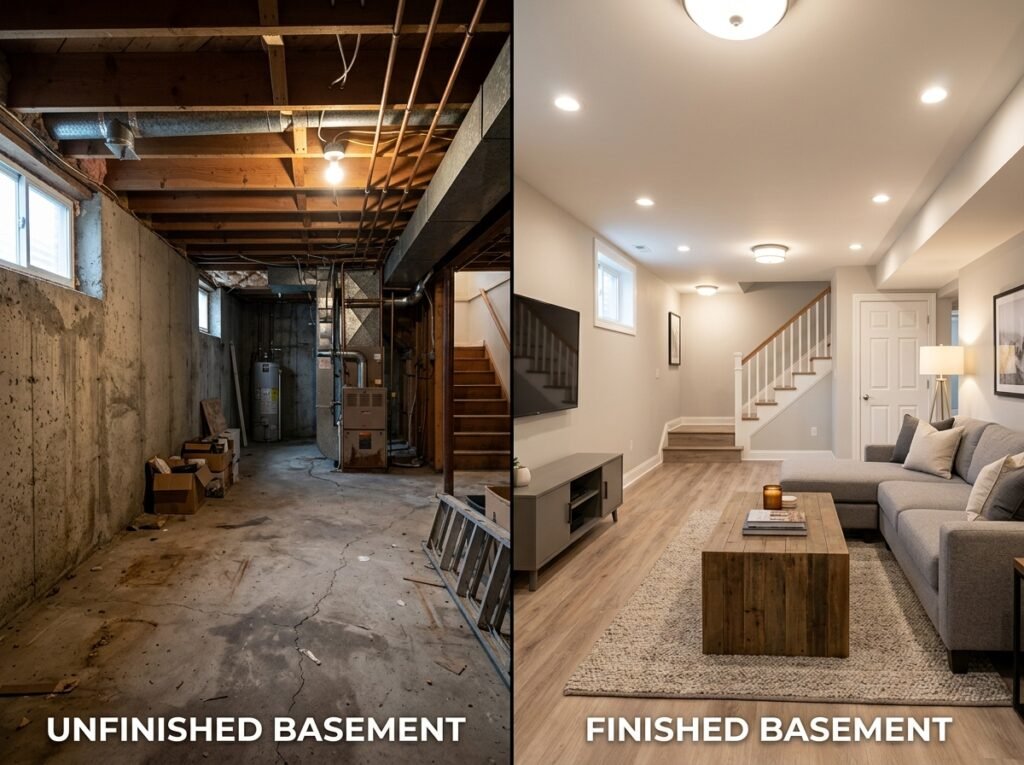
The most common Maryland basement project is converting raw square footage into a comfortable family room, media space, or entertainment area. This type of project extends the functional living space of the home without adding to the footprint valuable in suburban neighborhoods where lots are modest and additions are expensive or not permitted.
A well-designed family room basement includes open-concept layout for natural flow, recessed lighting on dimmers for flexible ambiance, LVP flooring that handles moisture better than hardwood or laminate, and a dedicated HVAC zone so the space is genuinely comfortable year-round rather than a cold afterthought in winter.
For entertainment-forward builds, we incorporate media room pre-wiring (HDMI, audio, and streaming), dedicated 20-amp circuits for AV equipment, acoustic insulation in ceiling and walls, and concealed wire channels. A raised platform section can create theater-style seating separation without requiring structural work a practical approach in a 7-foot ceiling space.
Typical cost range: $32,000–$65,000 for a 700–1,000 sq ft family room or entertainment space at mid-range finish.
Remote work, changing lifestyle priorities, and the proven ROI of avoiding a gym membership have made basement home gyms one of the fastest-growing use cases in Maryland basement finishing. The 2026 trend in Maryland is moving toward full wellness spaces not just a rubber-floored weight room, but integrated zones that combine workout space, recovery area, and in some cases spa-style bathroom with sauna or steam.
The technical requirements for a home gym basement are specific. Rubber flooring 8mm minimum for weight areas, 3/8-inch to 3/4-inch for cardio zones must be installed over a concrete subfloor that is fully moisture-mitigated and level. Ceiling height is critical; equipment like cable machines and pull-up rigs require 8-foot minimum, and ceiling fans for airflow need 7.5-foot clearance. Dedicated 20-amp circuits for treadmills, bikes, and ellipticals are standard, and HVAC zoning to manage the heat load from exercise is an essential consideration in Maryland’s humid climate.
For homeowners incorporating a sauna or steam room, additional electrical, plumbing, and ventilation work is required. A prefabricated sauna unit requires a 220V dedicated circuit. Steam generators require a dedicated water supply and drainage. These additions are fully manageable within a basement remodel project but require planning from the rough-in phase, not as an afterthought.
Typical cost range: $25,000–$55,000 for a 400–700 sq ft home gym at functional-to-premium finish; $40,000–$90,000+ for integrated wellness spaces with sauna, steam, and spa bathroom.
With hybrid and remote work now a structural feature of Maryland’s federal contracting, biotech, and technology workforce particularly in Rockville, Gaithersburg, Columbia, and Frederick dedicated below-grade home offices have become an investment in professional productivity, not just personal convenience.
What separates a serious home office from a desk in a finished basement room is sound isolation. Maryland homeowners in 2026 are specifying acoustic insulation in walls and ceilings, solid-core doors, and sound-dampening flooring as standard elements of their office build not premium upgrades. A finished office that sounds and functions like a professional environment increases both day-to-day work quality and the flexibility of the space when needs change.
Design elements that make basement offices work: natural-spectrum LED lighting to offset the below-grade light deficit, built-in desk and storage systems to maximize limited space without the bulk of freestanding furniture, and cat6 or fiber conduit installation that future-proofs the space for high-speed connectivity demands that evolve faster than construction cycles.
Typical cost range: $20,000–$45,000 for a dedicated home office of 300–600 sq ft with acoustic treatment and built-ins.
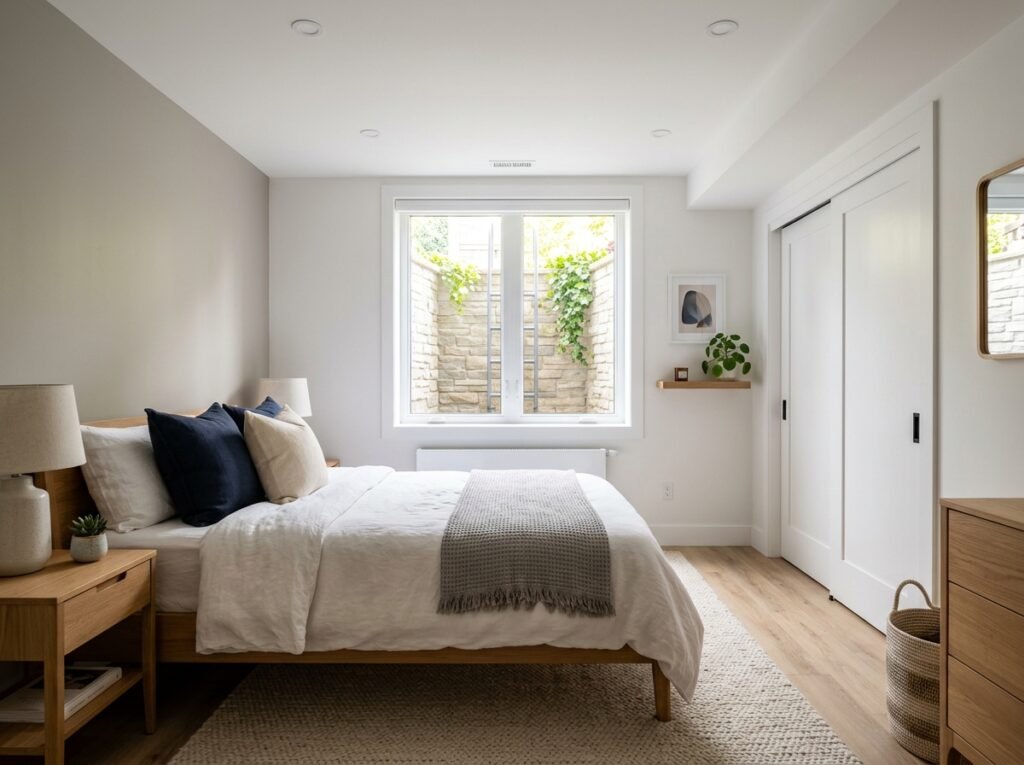
A finished bedroom in the basement expands your home’s bedroom count on paper and in practice creating genuine hospitality for guests, a private space for college students returning home, or a dedicated room for a caregiver. In Maryland’s housing market, where an extra bedroom materially affects appraisal value and buyer interest, a properly permitted basement bedroom with egress compliance is a tangible asset.
The requirements are specific and non-negotiable: egress window meeting Maryland’s Residential Code Section R310 minimums, 7-foot minimum ceiling height in the sleeping area, smoke and carbon monoxide detectors interconnected and hard-wired with battery backup, and proper insulation in walls (R-10 continuous or R-13 in framing cavities per Maryland code for basement walls enclosing conditioned space).
Add a closet and a nearby bathroom even a half bath at minimum, a full bath with shower for maximum value and you have a guest accommodation that competes with the home’s primary bedrooms in both function and finish.
Typical cost range: $25,000–$50,000 for a guest bedroom with egress, closet, and half bath. $40,000–$75,000 with a full bathroom.
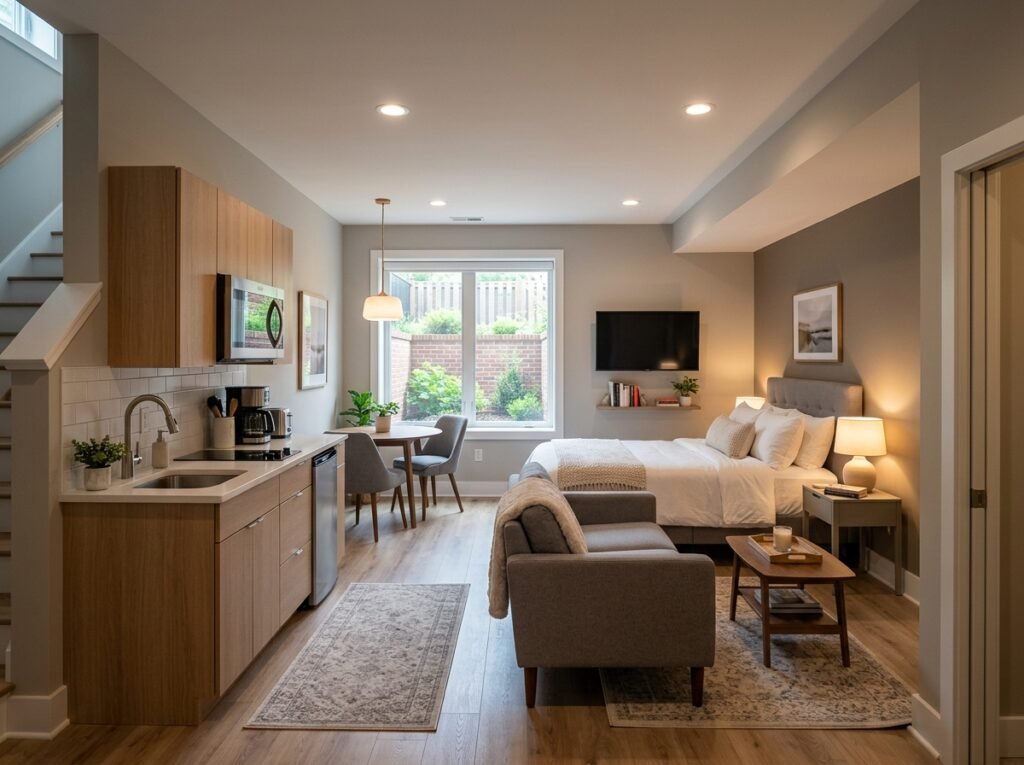
The in-law suite basement is one of the most strategic investments Maryland homeowners are making in 2026. Multigenerational living is gaining momentum across Maryland as housing costs keep adult children and aging parents under the same roof longer. A properly built, code-compliant basement ADU serves triple duty a private space for family members today, a rental unit generating income when not occupied by family, and a compelling listing feature when the home eventually sells.
A genuine in-law suite not just a finished basement with a bathroom, but a self-contained living space requires:
Private entrance: A walk-out or side exterior door that allows independent access without passing through the main living area
Full bathroom: A complete bathroom with shower, toilet, and sink
Kitchenette or full kitchen: At minimum a sink, small refrigerator, and microwave. A full kitchen adds cost but maximizes both livability and rental income potential
Legal sleeping room: Bedroom with egress window meeting Maryland’s code requirements
Fire separation: Where a rental unit is being created, Maryland code requires specific fire separation between the unit and the main dwelling typically 1-hour fire-rated wall and ceiling assemblies
Dedicated HVAC: A separate thermostat zone so the occupant controls their own climate independently
Soundproofing: Acoustic insulation in shared walls and ceiling between the suite and main living area
The rental income potential of a well-built Maryland basement ADU is substantial. In Montgomery County where the average rent for a one-bedroom apartment exceeds $1,700/month and vacancy sits below 4% a legal basement unit can command $1,200–$1,800/month depending on size and finish. In College Park near the University of Maryland, student housing demand pushes achievable rents higher for well-located basement units. In Towson, with 22,000+ Towson University students creating consistent rental demand, a properly finished basement suite is a straightforward income play.
ADU conversions run $85,000–$165,000 depending on scope, county, and finish level. That investment adds equity to the home that typically exceeds the construction cost in Maryland’s appreciation markets while generating meaningful monthly income during the hold period.
Typical cost range: $65,000–$165,000 for a full self-contained in-law suite with private entrance, full kitchen or kitchenette, full bathroom, legal bedroom, and dedicated HVAC.
Maryland Basement Remodeling Costs: Real Numbers by Scope
Cost transparency is the first thing homeowners ask for and the first thing many contractors avoid. Here are real Maryland-specific numbers based on current market conditions in 2025–2026.
Maryland’s DC-metro location places it firmly in the high-cost tier for construction. The national average for basement remodeling is $22,000–$55,000. In Maryland and the broader DC metro area, costs run 40–60% above national averages due to labor market pressure and stricter building code requirements.
Maryland basement remodeling cost tiers (per 1,000 sq ft, 2025–2026):
Basic Finish $32–$50 per square foot ($32,000–$50,000 for 1,000 sq ft) Framing, drywall, paint, LVP or carpet flooring, recessed lighting, basic electrical with outlets and switches, egress window if adding a sleeping room. This is the foundation of a functional living space that transforms raw concrete into a room your family will use.
Mid-Range Remodel $55–$85 per square foot ($55,000–$85,000 for 1,000 sq ft) Everything in the basic package plus: bathroom addition (half or full), dedicated HVAC zone, premium flooring, wet bar or kitchenette, media room pre-wiring, custom built-ins, accent lighting, and upgraded finishes throughout. This is the most popular tier for Maryland homeowners, and the range that delivers the strongest combination of livability and ROI.
Premium / In-Law Suite $85–$130+ per square foot ($85,000–$130,000+ for 1,000 sq ft) Full bedroom with closet and legal egress, complete bathroom with shower, kitchenette with sink and appliances, separate entrance, dedicated HVAC system, soundproofing, fire separation compliance, and all finishes for a self-contained living space that meets Maryland’s code requirements for habitable occupancy.
Luxury / Full Conversion $150–$300+ per square foot Custom home theater with projection and acoustic treatment, wine cellar with temperature control, full wet bar, spa bathroom, premium flooring throughout, smart home integration, and designer finishes at every surface. This tier applies to premium suburban markets like Bethesda, Clarksville, and Severna Park where the home value justifies the investment.
Individual component cost reference:
Bathroom addition (half bath): $6,000–$12,000 added during construction (doubles if retrofitting later)
Full bathroom with shower: $12,000–$25,000 depending on drainage depth and waterproofing
Egress window installation: $8,500–$15,000 per window including excavation and window well
Basement waterproofing (interior drainage + sump): $4,000–$15,000 depending on system complexity
Wet bar addition: $20,000–$40,000
Flooring (LVP, 1,000 sq ft): $8,000–$20,000 installed
Permit fees (Maryland counties): $100–$400+ for building permit; additional fees for electrical, plumbing, and mechanical permits total permit cost often runs $2,000–$5,000 for a full basement remodel
A turnkey 860 sq ft basement remodel in Montgomery Village was recently completed for $59,850 approximately $70/sq ft covering full demolition, rough-ins, installation, finishing, and cleanup. That real-world project figure reflects current mid-range pricing in Montgomery County.
One critical budgeting note: Always plan a 10–20% contingency above your contractor’s estimate. Maryland’s housing stock is old enough that discoveries during demolition rotted subfloor sections, outdated electrical panels, moisture intrusion behind existing finishes, or structural issues not visible before opening walls are the norm rather than the exception.
Maryland-Specific Basement Challenges: Moisture, Code, and County Compliance
Maryland basements are not the same as basements in Arizona or Texas. The state’s climate, soil composition, and housing stock age create a specific set of challenges that every basement project must address from the start.
Waterproofing: The Non-Negotiable First Step
Maryland’s clay-heavy soil holds water exceptionally well which is good for agriculture and terrible for below-grade construction. Fluctuating water tables, heavy seasonal rainfall, and the state’s humid subtropical climate create moisture pressure against basement walls that, if unaddressed, leads to seepage, mold, and structural deterioration within years of finishing.
Fortune Homes MD evaluates every basement for moisture before a single piece of framing goes up. We assess foundation walls, identify active seepage points, and determine the right combination of solutions for the specific conditions in your property:
Interior drainage systems: Channel drains installed at the footer perimeter, directing water to a sump pit before it can reach finished surfaces
Sump pump installation or replacement: Submersible pumps with battery backup systems that continue operation during the power outages Maryland storms regularly cause
Vapor barriers: Sealed membrane systems applied to walls and floor to block moisture migration through concrete and block
Waterproofing coatings: Applied to masonry walls as a supplemental moisture barrier layer
Exterior grading correction: Redirecting surface water away from the foundation at the perimeter
Skipping waterproofing to save money upfront is the single most common mistake in Maryland basement finishing. Mold remediation after a finished basement floods costs $15,000+ and that’s before the cost of repairing or replacing the finished work. We solve the water problem first. Everything built on top of that is protected.
Maryland Egress Window Requirements
Any sleeping room created in a Maryland basement requires an egress window this is mandated by Maryland’s Residential Code (Section R310) and enforced by every county building department. The requirements are specific:
Minimum net clear opening area: 5.7 sq ft (5.0 sq ft for grade-floor openings)
Minimum clear opening height: 24 inches
Minimum clear opening width: 20 inches
Maximum height from finished floor to bottom of clear opening: 44 inches
Window must be openable from the inside without keys, tools, or special knowledge
If a window well is required, it must have a minimum horizontal area of 36 inches × 36 inches
Every sleeping room in a basement must have its own egress opening. A finished basement with two bedrooms requires two compliant egress windows. This is not negotiable with inspectors, and unpermitted basement bedrooms without egress are one of the most common disclosure issues that create problems at the time of sale.
Fortune Homes MD coordinates egress window installation as part of every basement project that includes a sleeping room handling excavation, window selection, window well installation, and building department inspection coordination.
Ceiling Height Requirements
Maryland’s Residential Code requires a minimum ceiling height of 7 feet for habitable rooms, hallways, and corridors. Bathrooms, toilet rooms, and laundry rooms require a minimum of 6 feet 8 inches. Beams, girders, ducts, and other obstructions may not project within 6 feet 4 inches of the finished floor.
This is a critical evaluation item before any basement project begins. Maryland homes particularly older colonial and cape cod-style construction in Baltimore County, Anne Arundel County, and Howard County frequently have unfinished basements with 7-foot or 7.5-foot ceilings that accommodate basic finishing but limit design options. Older rowhomes in Baltimore City may have basement ceilings as low as 6 feet 4 inches, which precludes habitable finishing without structural intervention.
We assess ceiling height clearances as the first question on every basement project before discussing finishes, layout, or budget because it determines what’s actually buildable in the space.
Maryland County Permit Requirements: What You Need to Know
One of the most common frustrations in Maryland basement remodeling is discovering after work has begun or after a project is complete that required permits were not obtained. Unpermitted work creates disclosure obligations at sale, can void homeowner’s insurance for renovation-related claims, and may require demolition of completed work if a stop-work order is issued.
Fortune Homes MD pulls all required permits before any work begins. Here’s how permit requirements break down across the counties we serve:
Baltimore County: All basement finishing requires a building permit for structural work (framing, wall layout, egress window installation). Separate electrical, plumbing, and mechanical permits are required for trade work. Basement bedrooms require egress windows with prescribed openings Baltimore County building department enforces these during the inspection sequence. All permits must include the MHIC license number of the prime contractor. Applications are submitted through Baltimore County’s online portal.
Anne Arundel County: Building permit required for structural changes, egress windows, framing, and drywall. Electrical, plumbing, mechanical, and fire protection permits required for respective trade work. All permits applied through the county’s Land Use Navigator portal. City of Annapolis uses a separate Annapolis Permitting System. Inspection sequence: plumbing groundwork → rough trade inspections → framing and close-in → insulation → final trade inspections → final building inspection.
Montgomery County: Alteration building permit required for basement finishing and renovation. Trade permits for electrical, plumbing, and mechanical work as applicable. The county’s permit process often includes plan review budget 8–12 weeks for permit approval during peak season if plans are submitted at the start of project design.
Howard County: Building, electrical, plumbing, and mechanical permits required depending on scope. Basement bedrooms require egress compliance. Howard County’s permit process is coordinated through the Department of Inspections, Licenses, and Permits (DILP).
Prince George’s County: Permits required for structural work, trade systems, and egress modifications. MHIC license required on all permit applications. County PRSA rent regulations affect classification of new basement rental units.
Frederick County: City of Frederick uses its own permitting system separate from Frederick County. A building permit is required for structural changes, framing, drywall, and egress windows. Note: Frederick County Ordinance requires all new dwelling units to be sprinklered this applies to new ADU construction in the county and affects in-law suite projects specifically.
Contractor licensing: Maryland law requires that the prime contractor on any home improvement project hold an active MHIC license and be responsible for obtaining all required permits before work begins. Permits must display the contractor’s MHIC number. All Fortune Homes MD basement projects are managed by MHIC-licensed contractors.
The Fortune Homes MD Basement Remodeling Process
Step 1 Basement Assessment and Design Consultation We begin with a walkthrough of your specific basement. We assess ceiling height and egress options, evaluate moisture conditions and identify risk areas, review the existing mechanical, electrical, and plumbing systems, and discuss your goals for the space. From that conversation, we establish what is realistically buildable and what the project will cost.
Step 2 Design and Scope Development We develop a detailed floor plan and scope of work room layout, lighting plan, electrical plan, plumbing locations, HVAC zoning, finish specifications, and a line-item budget. We build the 10–20% contingency into the budget at this stage, not after construction begins.
Step 3 Permit Applications We submit all required permits to the appropriate county or city permitting office before mobilizing trade contractors. We coordinate plan review requirements, manage any corrections or clarifications requested by the building department, and schedule trade permits in parallel with the building permit process.
Step 4 Waterproofing and Pre-Construction Before framing begins, we address moisture. Interior drainage installation, sump pump installation or upgrade, and vapor barrier systems are completed first. This is not an optional step in Maryland.
Step 5 Rough Construction: Framing, Mechanical, and Rough-Ins Framing, rough electrical, rough plumbing, and HVAC ductwork are installed according to the approved plans. Rough inspections are coordinated with the county for each trade before closing in the walls.
Step 6 Insulation, Drywall, and Close-In Insulation is installed (R-10 continuous or R-13 in framing cavities for basement walls per Maryland code), inspected, then drywall is hung, taped, and finished. Close-in inspection is coordinated with the county.
Step 7 Finishes Flooring, trim, doors, cabinetry, fixtures, lighting, paint, and all specified finishes are installed. This is where the project transforms from a construction site into the space you envisioned.
Step 8 Final Inspections and Certificate of Completion All trade final inspections are completed. Final building inspection is scheduled and passed. Certificate of completion (or occupancy for ADU projects) is obtained. The space is yours fully permitted, fully code-compliant, and built to last.
Frequently Asked Questions About Maryland Basement Remodeling
Ready to Finish Your Maryland Basement?
Fortune Homes MD serves homeowners and investors across Maryland with full-service basement remodeling from the first moisture assessment through the final inspection and certificate of completion. Every project is permitted, code-compliant, and MHIC-licensed from start to finish.
Contact Fortune Homes MD
📞 Phone: +1 (410) 413-0739
📧 Email: info@fortunehomesmd.com
📍 Office: 3701 Old Court Rd, Suite 5B Baltimore, MD 21208
Business Hours:
Monday – Friday: 7:00 AM – 6:00 PM
Saturday: 8:00 AM – 4:00 PM
Sunday: Closed
We serve homeowners across Baltimore County including Towson, Dundalk, Catonsville, Essex, and Parkville Montgomery County including Rockville, Bethesda, Silver Spring, Gaithersburg, and Germantown Howard County including Columbia and Ellicott City Prince George’s County Anne Arundel County including Annapolis, Glen Burnie, Severna Park, and Pasadena Frederick County and Baltimore City.