
Code Compliance Maryland The Inspection Sequence That Every Maryland Flip Must Pass
Code compliance is the system that verifies every permitted renovation phase meets Maryland’s building code requirements before the project proceeds to the next phase. It protects the investor from the two most costly compliance failure modes: a failed final inspection that prevents listing until corrections are made, and a buyer’s lender appraisal that identifies code violations and refuses to fund the buyer’s mortgage until violations are corrected. Either scenario adds weeks to the project timeline and thousands in carrying cost after the renovation work is otherwise complete.
Maryland follows the International Residential Code (IRC) 2021 with state-level amendments adopted through the Maryland Building Performance Standards, plus county-specific local amendments. Baltimore City maintains its own Baltimore City Building Code amendments that supplement the state IRC adoption. The inspection sequence required in Maryland rough trade inspections before insulation, insulation before drywall, all intermediates before final is not flexible. Work that covers uninspected phases must be opened for inspection access when discovered. The cost of skipping an inspection step is not a permit fee, it is demolition and reconstruction of completed work.
Fortune Homes MD builds the full Maryland inspection sequence into every project schedule from Day 1. No shortcuts that move a completion date forward by a few days but create a compliance failure that moves the listing date back by a few weeks. The inspection sequence is the schedule, not an obstacle to it.
We serve: Baltimore County · Montgomery County · Howard County · Prince George’s County · Anne Arundel County · Frederick County · Carroll County
📞 (410) 413-0739 📧 info@fortunehomesmd.com

The Maryland Code Framework Which Code Applies Where
County / Jurisdiction | Governing Code | Key Local Amendments or Notes |
Baltimore City | IRC 2021 + Baltimore City Building Code amendments | Additional amendments include: party wall structural requirements, ground rent-related title requirements for permit issuance, CHAP exterior alteration standards for historic district properties, lead paint RRP Rule integration with Baltimore City MDE requirements |
Baltimore County | IRC 2021 + Baltimore County amendments | Explicit inspection sequence documentation (plumbing groundwork → trade inspections → building inspections). PAI Ombudsman available for code interpretation. |
Montgomery County | IRC 2021 + Montgomery County amendments | Historic district overlay codes for designated areas. WSSC (Washington Suburban Sanitary Commission) code governs all plumbing affecting the public water/sewer system. |
Howard County | IRC 2021 + Howard County amendments | Generally aligned with state IRC with minimal additional amendments. One of the most straightforward code compliance environments in Fortune Homes MD service area. |
Prince George’s County | IRC 2021 + PG County amendments | WSSC governs plumbing affecting the public system. FHA minimum property standards interact with code requirements for properties targeting the FHA buyer pool. |
Anne Arundel County | IRC 2021 + AA County amendments | Health Department code governs private well and septic work. FEMA flood zone requirements for properties in designated flood areas. |
Frederick County | IRC 2021 + Frederick County amendments | Minimal additional amendments beyond state IRC. USDA property condition standards apply for properties in USDA rural financing zones. |
Carroll County | IRC 2021 + Carroll County amendments | Least complex code environment in Fortune Homes MD service area. Health Department code governs well and septic work on rural properties. |
The Maryland Inspection Sequence Required Order for All Permitted Work
The sequence below reflects Maryland IRC 2021 requirements as applied in all Fortune Homes MD service counties, with Baltimore County’s explicitly documented trade-then-building inspection sequence as the reference framework.
Inspection 1: Rough Plumbing Inspection
When scheduled: After all new supply piping, DWV (drain-waste-vent) runs and ground slab plumbing are complete before any walls are insulated or covered
Inspector verifies: Supply pipe sizing, pressure test of supply system, DWV slope (minimum 1/4″ per foot), trap and vent requirements, any below-slab work
Must pass before: Any insulation in plumbing wall cavities or floor areas. Any drywall in plumbing areas.
Failure consequence: Rework required. Re-inspection scheduled. Minimum 3–7 day delay before insulation can begin.
Fortune Homes MD protocol: Pre-inspect rough plumbing internally before calling the county inspector. Schedule inspection immediately when work is complete not after a ‘review period’ that adds idle days.
Inspection 2: Rough Electrical Inspection
When scheduled: After all new circuit rough-in, panel work, recessed can boxes, device boxes and any conduit runs are complete before insulation
Inspector verifies: Wire sizing for circuit loads, AFCI/GFCI protection requirements, panel labeling, box fill calculations, stapling and support requirements
Must pass before: Any insulation in electrical wall cavities or ceiling spaces. Any drywall in electrical areas.
Failure consequence: Rework required. Re-inspection scheduled. Cannot begin insulation in any area with open electrical rough-in failures.
Maryland-specific: AFCI circuit protection requirements apply to nearly all branch circuits in Maryland residential renovation under IRC 2021. Confirm AFCI specification with the electrician before rough-in begins.
Inspection 3: Rough Mechanical / HVAC Inspection
When scheduled: After all ductwork runs, equipment rough-in locations, refrigerant line rough-in, and all gas line rough-in are complete before insulation
Inspector verifies: Ductwork sizing and routing, gas line pressure test, combustion air requirements, refrigerant line support, gas appliance clearances
Must pass before: Any insulation in mechanical areas or over ductwork. Any drywall in HVAC chase areas.
Failure consequence: Gas line pressure test failure requires leak identification and repair before re-test. This is a common delay point if gas line work is rushed.
Fortune Homes MD protocol: Gas line pressure test performed by HVAC contractor before county inspection is called confirms the test will pass before inspector time is spent.
Inspection 4: Framing / Insulation Inspection
When scheduled: After ALL three trade rough-in inspections pass AND insulation is installed
Inspector verifies: Framing modifications match approved plans (load path, header sizing, connector hardware), insulation type and R-value per energy code requirements, vapor barrier installation
Must pass before: Any drywall installation anywhere in the project
Failure consequence: Insulation deficiency requires correction and re-inspection. Incorrect framing modification requires structural engineering review, additional materials and re-inspection. Both delay drywall start.
Maryland energy code: IRC 2021 Energy provisions wall insulation minimum R-13 (MD climate zone 4), attic R-38 minimum, floor over unconditioned space R-30 minimum. Confirm insulation specs meet Maryland energy code before installation begins.
Inspection 5: Intermediate / Drywall-In-Progress (where required)
When scheduled: Some Maryland counties require an intermediate inspection during or before drywall completion confirm requirement at permit issuance
Inspector verifies: Fire blocking, draft stopping, any code-required blocking for future ADA hardware (grab bars require backing in all Maryland bathrooms per best practice)
Must pass before: Drywall completion or taping in areas subject to intermediate inspection
Maryland-specific: Fire blocking in wall cavities between floors, around chimneys and in specific framing configurations is a common intermediate inspection finding to ensure the framing team is familiar with Maryland fire blocking requirements.
Inspection 6: Final Building Inspection
When scheduled: After ALL work is complete all systems operating, all finishes done, all punch list items closed
Inspector verifies: Entire renovation meets permitted scope and code requirements. Egress windows in sleeping rooms (IRC R310 minimum 5.7 sq ft opening, 24″ height, 20″ width, maximum 44″ sill height). Smoke and CO detector installation. Handrail continuity. Stair dimensions.
Must pass before: Certificate of Occupancy issuance (where required by county). Listing the property.
Failure consequence: Any item failing final inspection must be corrected before a CO is issued or the listing proceeds. Common final inspection failures: missing smoke detectors, non-code-compliant handrail, improperly installed GFCI protection, missing or incorrect AFCI protection.
Fortune Homes MD protocol: Final inspection pre-walk with the MHIC project manager 48 hours before the county inspection. Every code item is verified internally before the inspector arrives.
Inspection 7: Final Trade Inspections (Electrical, Plumbing, Mechanical)
When scheduled: Same day or immediately adjacent to final building inspection all final trade inspections completed as a group where possible
Electrical final: All devices, fixtures, panel breakers, AFCI/GFCI protection, panel schedule, load calculations
Plumbing final: All fixture connections, water pressure, drain function, water heater installation, PRV settings
Mechanical final: HVAC system operation, gas appliance connections, exhaust fan ducting, refrigerant charge
All trade finals must pass before Certificate of Occupancy is issued.
🔶 Need Code Compliance Management for Your Maryland Flip?
Every inspection is scheduled proactively. No failures. No surprises at listing.
📞 (410) 413-0739
📧 info@fortunehomesmd.com
→ Permit Management | → Quality Control | → Contractor Coordination
Maryland-Specific Code Requirements What Baltimore City Adds
- Lead paint RRP Rule compliance: All pre-1978 renovation (virtually all Baltimore City properties) must use EPA RRP Rule certified contractors and follow lead-safe work practices. Renovation, Repair and Painting (RRP) Rule: containment, specialized cleanup procedures and post-renovation testing. Violations: up to $37,500 per violation per day under federal enforcement.
- CHAP exterior alteration standards: Baltimore City historic district properties must comply with CHAP (Commission for Historical and Architectural Preservation) exterior standards: historically appropriate window profiles, masonry materials and pointing specifications, period-appropriate roof materials on visible slopes. Inspected by CHAP before any exterior work begins.
- Party wall notification: Baltimore City rowhouse party walls (shared structural walls between adjacent rowhouses) require neighbor notification before any structural work affecting the party wall begins. Baltimore City’s party wall ordinance governs this process.
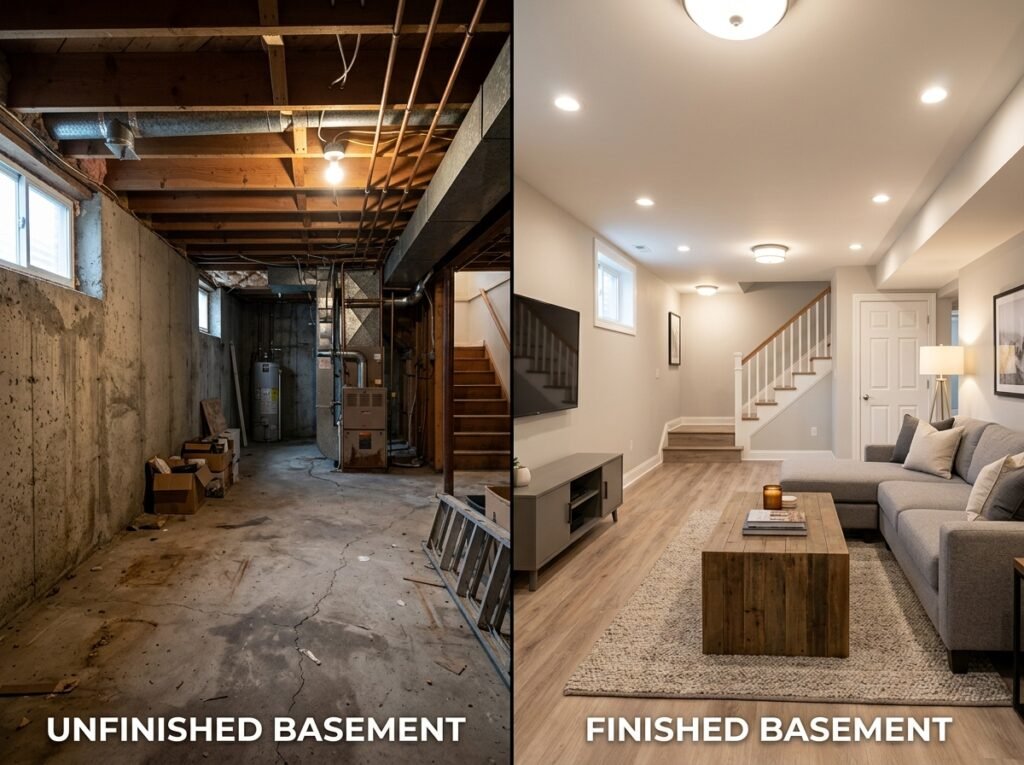
- Egress window requirement (sleeping rooms): IRC R310 requires all habitable sleeping rooms to have an egress window with minimum 5.7 sq ft net clear opening area, 24″ minimum clear opening height, 20″ minimum clear opening width, and maximum 44″ sill height from the floor. Any basement bedroom conversion must include a code-compliant egress window both for code compliance and for the property’s legal bedroom count (which directly affects the ARV).
FAQs Code Compliance Maryland
Maryland residential renovation is governed by the International Residential Code (IRC) 2021, adopted through the Maryland Building Performance Standards with state-level amendments. Each county adds its own local amendments on top of the state adoption Baltimore County has explicit inspection sequence documentation, Montgomery County has WSSC plumbing code coordination requirements, and Baltimore City has the most extensive local amendments including CHAP historic district standards, lead paint RRP Rule integration and party wall requirements. Fortune Homes MD’s compliance management framework accounts for all state IRC requirements, county-specific amendments and Baltimore City’s unique code environment in every project.
Maryland’s IRC 2021 inspection sequence for a permitted fix-and-flip renovation is: (1) rough plumbing inspection before any insulation covers plumbing rough-in; (2) rough electrical inspection before insulation; (3) rough mechanical/HVAC inspection before insulation; (4) framing/insulation inspection after all three trade rough-ins pass AND insulation is installed; (5) intermediate inspection (where required by county) fire blocking, draft stopping; (6) final trade inspections (electrical, plumbing, mechanical) after all work is complete; (7) final building inspection all work complete, all systems operating, all finishes done. No phase can proceed until the prior phase’s inspection passes.
The EPA’s Renovation, Repair and Painting (RRP) Rule requires that all renovation work on pre-1978 residential properties be performed by RRP-certified contractors using lead-safe work practices: containment of work area, specialized cleanup procedures, and post-renovation verification testing. In Maryland, virtually all Baltimore City housing stock is pre-1978, meaning the RRP Rule applies to essentially every Baltimore City fix-and-flip renovation. The Maryland Department of the Environment coordinates with EPA on enforcement. Violations: up to $37,500 per violation per day under federal enforcement. Fortune Homes MD’s entire renovation team is RRP-certified and builds lead-safe practices into all pre-1978 renovation scopes as a standard not an optional add-on.
An egress window is a window that meets IRC R310’s minimum requirements for emergency escape from a sleeping room: net clear opening area of at least 5.7 square feet, minimum 24″ clear opening height, minimum 20″ clear opening width, and maximum 44″ sill height from the floor. Any room marketed as a bedroom must have a code-compliant egress window both for IRC compliance and for the property’s legal bedroom count. On a Maryland flip, every bedroom must have an egress window that passes final building inspection. This is particularly important for any basement bedroom conversion, where the egress window installation may also require excavation for a window well. The egress window installation is a Gate 6 due diligence and Gate 2 renovation scope item it must be budgeted before acquisition.
Fire blocking is a code-required method of closing concealed spaces in wood frame construction to prevent the spread of fire through wall cavities, floor cavities and other concealed spaces. Maryland’s IRC 2021 adoption requires fire blocking at ceiling and floor levels, at the top of stairways, around chimneys and fireplaces, and in other specific framing configurations. Fire blocking is a common intermediate or framing inspection finding in Maryland fix-and-flip renovations particularly in older properties where original framing pre-dates the fire blocking requirements and where renovation has opened wall cavities that now require code-compliant fire blocking before they are closed with drywall.
Still have a question?
Related Renovation Services
Feature | Details |
PM System | System 5 of 6 Code Compliance |
Governing Code | IRC 2021 + Maryland state amendments + county-specific local amendments |
Baltimore City Extra | Baltimore City Building Code amendments | CHAP standards | RRP lead paint | Party wall ordinance |
Inspection Sequence | Rough plumbing → rough electrical → rough HVAC → framing/insulation → intermediate → final trades → final building |
RRP Rule | All pre-1978 MD properties (virtually all Baltimore City) RRP-certified contractors required |
Egress Requirement | All sleeping rooms: 5.7 sq ft net clear opening | 24″ height | 20″ width | 44″ max sill |
AFCI Requirement | Nearly all branch circuits in MD residential renovation under IRC 2021 |
Energy Code (MD Zone 4) | Wall R-13 min | Attic R-38 min | Floor over unconditioned R-30 min |
Final Inspection Protocol | Internal pre-walk 48 hrs before county inspector every code item verified before inspection day |
Service Area | 7 Maryland counties |
Phone | (410) 413-0739 |
info@fortunehomesmd.com |